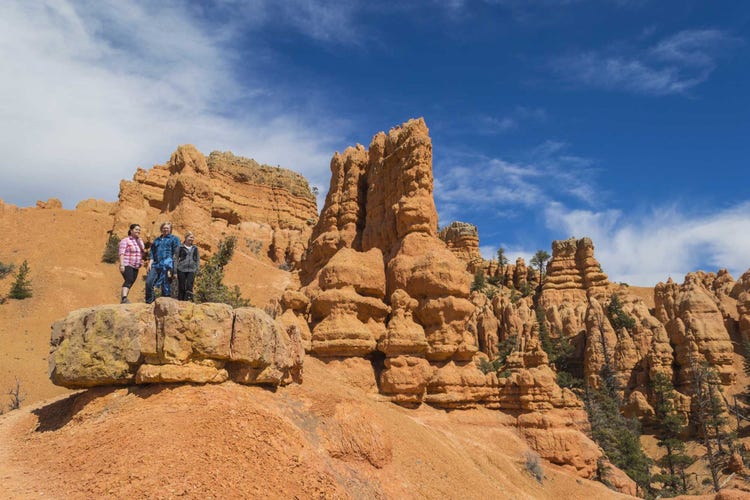
Tips For The Hiking Trails
Just two pieces of advice before you hike these magnificent trails:
(1) Take plenty of water
(2) Don't forget your camera!
Red Canyon Trail System
The Red Canyon Trail System is open year-round for guests to explore a different perspective of the “crown jewels” of Bryce Canyon National Park as well as the unique views and geology of Dixie National Forest. The Red Canyon Trail System offers well-maintained paths that are less crowded but still abundant with geological wonders.
- Pink Ledges
- Hoodoo
- Birdseye
- Golden Wall
- Losee Canyon Trail
- Thunder Mountain - Mountain Biking
- Red Canyon Bicycle Trail - Biking
- Casto Canyon Trail - Off-highway vehicles
Bryce Canyon National Park Hiking
Bryce Canyon National Park has hiking trails for every guest, from beginners to more experienced hikers. Take a stroll around the infamous Bryce Amphitheater on the Rim Trail or choose a more challenging hike to explore the hoodoos on the Peekaboo Loop. Whichever trail is chosen, the hoodoos will enchant you.
Bryce Canyon National Park is a federally protected area. To help preserve the park resources and for your protection, please observe the following rules on park trails:
- Pets, including ADA-registered animals, are only allowed on paved trails, viewpoints, roads, campsites, and picnic areas. Pets must be on a leash at all times.
- Do not climb hoodoos or stray from maintained trails.
- Feeding wildlife is prohibited.
- Stay on trails to protect vegetation and avoid wildlife confrontations.
- Bicycling is allowed only on paved surfaces.
- Be prepared! Park elevations reach over 9,000 feet. Equip yourself with water, food, and proper clothing and shoes. Elevation may cause nausea and dizziness.
- Check the weather before hiking. Lightning is a year-round danger to hikers.
- Hikers must yield to horses/mules on trails.
- In the winter, crampons and ski poles are strongly advised.
Safety at High Elevation:
Bryce Canyon National Park is a high-elevation park, with most of the park being at 8,000 feet or above. At this level, there is 70% of the oxygen present at sea level. It is important for hikers to make elevation a factor when choosing their hiking trail.
Due to the high elevation, storms and other dangerous weather conditions can form quickly. Take shelter immediately if thunder roars.
Easy Hikes
Easy hikes are partially paved trails with gentle grades and minimal elevation changes.
Est. Time: 1 hour
Elevation Change: 40 ft (12 meters)
Est. Time: 1 hour
Elevation Change: 150 ft (46 meters)
Est. Time: 1 hour – 7.5 hours
Elevation Change: 719 ft (219 meters)
Est. Time: 1 hour
Elevation Change: 200 ft (61 meters)
Moderate Hikes
Moderate hikes have steep grades with “down and back” elevation changes.
Est. Time: 1-2 hours
Elevation Change: 450 ft (137 meters)
Est. Time: 1-2 hours
Elevation Change: 625 ft (191 meters)
Est. Time: 2 – 3 hours
Elevation Change: 760 ft (232 meters)
Est. Time: 3 – 4 hours
Elevation Change: 800 ft (244 meters)
Strenuous Hikes
Strenuous hikes are long distance, steep grade trails with multiple elevation changes. These are particularly challenging hikes, even for avid hikers. Rule of thumb: Per 2-3 hours of hiking, carry 1 quart of water.
Est. Time: 4 – 5 hours
Elevation Change: 1900 ft (579 meters)
Est. Time: 3 – 4 hours
Elevation Change: 1560 ft (474 meters)
Est. Time: 3 – 4 hours
Elevation Change: 1380 ft (421 meters)
Est. Time: 4 – 5 hours
Elevation Change: 1575 ft (480 meters)
Est. Time: 3 – 4 hours
Elevation: 1145 ft (349 meters)